


Industry Tough Times Still Ahead
As might be expected, the picture emerging from the NPES Print Outlook conference was not a pretty one. One speaker after another provided gloomy forecasts for print in the year ahead. Two points of general agreement worthy of note are that print no longer tracks with the general economy, and the recovery in the printing and imaging industry will lag behind the overall economy. This latter point is particularly important because economic reports being released in early December are causing some economists to suggest that the recession is bottoming out.
Supporting that line of thinking, Ron Davis, Printing Industries of America economist, reviewed some lessons learned from the early 1990s recession. In that recession, both the print sales decline and the recovery lagged the economic decline and recovery by two quarters. NPES consulting economist Michael G. Evans, Evans Economics, said that this recession's impact on the printing and imaging industry has been more severe. He does not see recovery beginning until 2003. Evans noted that profits have fallen much more than in previous recessions.
Andrew Paparozzi, Chief Economist at the National Association for Printing Leadership, says the numbers are the worst he has seen in his 17 years in the industry. Despite this, he is a bit more optimistic than others, predicting moderate growth by the end of 2002, accelerating rapidly in 2003. He reiterates what many people are saying, that this is not just another recession, it is part of a structural change in the industry. However, from his conversations with printers, he is encouraged that many are beginning to see this as an opportunity to evolve from a printer to a communications business.
A lot of time was spent discussing the future of the industry. Keith Davidson, Davidson Communications, started off with an overview of factors affecting the future of the industry. One of the more sobering statistics he offered was the estimate that every year, 1,000 printers with 50 or less employees are disappearing. In his presentation, Vincent Naselli, Director of the TrendWatch Graphic Arts program, indicated that for the first time, "economic conditions" had become the number one challenge of printers.
 |
|
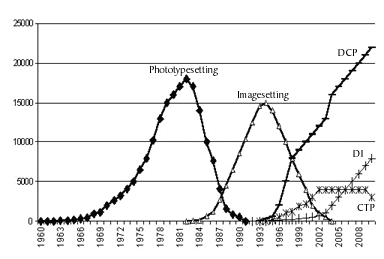
50 years of Pre-Press, World Wide Shipments 1960 - 2010 |
Frank Romano, Chairman, School of Printing Management and Sciences at the Rochester Institute of Technology, addressed the question, "Can Traditional and Digital Technologies Adapt to Current Economic and Market Conditions?" He predicts that further consolidation will occur in the mid sized companies and this portends continuing major changes. While large companies account for 63 percent of industry revenue, by 2010 small companies (under $2 million in annual sales) will represent 75 percent of companies. Romano believes that CTP sales are already leveling off and will begin to decline before the end of the decade, with digital imaging presses being the future area of growth for this decade. Everyone is aware of the impact of technology. Romano put a figure to it, estimating the loss to electronic competitors of $36 billion dollars over the last three years, with an additional estimated loss of $2 billion in related products and services. He then went on to expound on the domino effect of this trend.
Most speakers see a very changed industry in the years ahead, but one with opportunities for those willing to adapt to a changing industry.