



A Multi-Perspective Economic Outlook
Recovery Beginning Mid-year '02, Industry In '03
This report and the one beginning on page 3 attempt to capsulize data from a variety of sources and look ahead at 2002 and beyond. NAGASA gratefully acknowledges information supplied by the American Machine Tool Distributors Association, the National Association for Business Economics, NPES - The Association for Suppliers of Printing, Publishing and Converting Technologies and the economists and presenters at the NPES Print Outlook conference.
Economists at the recent Print Outlook 02 conference suggested that while the economy is more resilient in this post 9-11 period than some had expected, a turn-around is not expected before mid 2002. The National Association for Business Economics (NABE) panel of 33 forecasters is slightly more optimistic, "with 82 percent of panelists expecting a return to sustained positive growth in the first half of 2002."
 Unemployment estimates were revised sharply upward by the NABE panelists. The panel now projects unemployment will be at 4.8 percent at the end of 2001, increasing to 5.9 percent in 2002. NPES consulting economist Michael Evans is more pessimistic, predicting unemployment will hit 6 percent by the end of 2001 and rise to 7 percent in 2002.
There are a number of caveats that could affect these forecasts:
- Will Congress be able to reach some agreement on an economic stimulus plan?
- What will be the impact from the feeding frenzy for pet spending projects by members of both parties on Capitol Hill?
- If there are additional acts of terrorism, as many government officials are warning, what will happen to consumer confidence, which is a key ingredient to recovery? How will the manufacturing sector be impacted, as there is no way for economists to factor terrorism into their projections?
- How will the stock market, which tends to lead recovery in the economy by a number of months, react to the following events:
- Release of 4th quarter economic and corporate earnings reports.
- Predicted announcements of substantial additional layoffs early in 2002.
- The rapid disappearance of the budget surplus and the announcement that deficits are expected for the next several years.
The downturn in the manufacturing sector started as long as 18 months ago. Industrial capacity utilization has seen a precipitous drop-off in the past year. It is now at the lowest level in 18 years according to Andrew Paparozzi, Chief Economist at NAPL, the National Association for Printing Leadership. Current sales represent the selling off of excess inventory. Capacity utilization will not improve until this process has been completed.
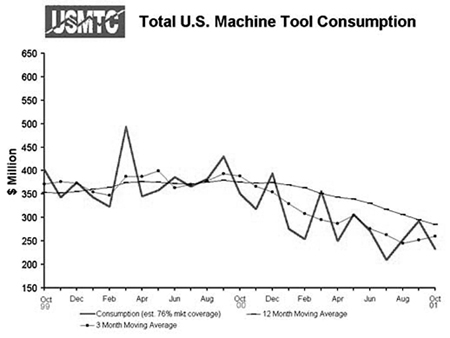 The USMTC machine tool orders tracking program is a very useful leading economic indicator. This program tracks orders, not shipments, thus it provides data weeks to months ahead of tracking programs in other industries. The USMTC data confirms the fact that the business sector downturn began in 2000. Orders are off by 1/3 for the first nine months of 2001 compared to 2000, and the most recent 3 month moving average continues to show decline.
Until capacity utilization increases, ultimately leading to new orders for machine tools and other industrial equipment, recovery in the manufacturing sector of the economy cannot be expected. Consumer confidence, and how that translates into fourth quarter 2001 and first quarter 2002 spending, will determine the consumer role in the recovery.
Resources: