



The Compass Winter 1998 The
Compass || Summer
1998 The
Compass || Summer
1998 |
||
|
THE Source for Channel Direction in Printing and imaging Distribution
|
||
|
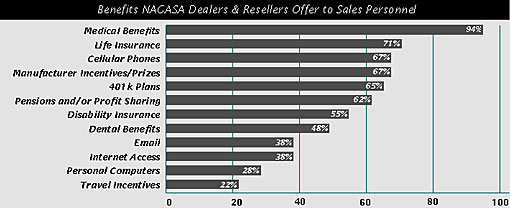
Study Focus Sales commissions and salaries account for the single largest cost of sales items that management has control of. The challenge to dealers with establishing compensation for sales staff is to find a mutually satisfactory middle ground -- maintaining a balance between compensation so low that good performers move to competitors, and letting compensation get so high that personnel become lazy or fail to seek new business. Manufacturers need to understand the dealer compensation practices of peers so that the ideal sales programs can be made most effective. Of the 69 dealers who participated in the 1998 NAGASA Sales Compensation Survey, 44 sell Typical of the information in the final survey report are details of the fringe benefits offered by dealers to their sales personnel. The chart below shows the percentage of all 69 dealers offering various fringe benefits. The actual final report shows how these offerings vary according to dealer size and sales mix. Of particular interest to manufacturers is a wealth of information detailing the use of sales specialists by dealers and how these digital age personnel are compensated. The 1998 survey, The 1998 NAGASA Sales Compensation Survey is a fact-filled 52-page report with extensive analysis and comparisons to similar surveys conducted in 1994 and 1996. The report helps explain trends in the industry as well as benchmark current operations. The cost of the survey is $95 for members and $155 for non-members, including postage and handling (special shipping and handling for overnight and foreign service). The report is free to participants. Call NAGASA at 202-328-8441 or order via the web site at www.nagasa.org. |
NAGASA © 1998